The Position of Nowruz in International Relations
Dr. Malek Setiz – Researcher in International Relations and University Professor
Translator: Nadima Rassuli – PhD candidate at Fulda University of Applied Sciences
Foreword
The history of Nowruz and the antiquity of this magnificent celebration have been extensively discussed by numerous scholars. In this article, I aim to explore the significance of Nowruz in fostering relations among states that, historically and geographically, fall within the sphere of this ancient festival. The history of international relations has shown that culture serves as a crucial factor in bringing states together. Alongside the economy, culture paves the way for shared state interests and lays the groundwork for the development of both historical and modern states. Ancient history emerged from the interplay of economic and cultural powers. This dynamic began with the alignment of local powers that, around seven thousand years ago, established a form of order. During this period, these local powers, which laid the foundations for ancient states or proto-states, built their relations on cultural recognition and rudimentary economic development. These ties started with mutual bilateral interests and evolved into the next phase of international relations, which we call triangular development or the development triangle. In this stage, third powers sought to align with or join the bilateral relations of these proto-states or early governments. Here, too, culture played a pivotal role, significantly contributing to state convergence. The convergence of states took centuries, leading to the formation of modern nation-states, a process historically traced back to the post-Renaissance and Enlightenment eras in Europe. In this period, political culture, born from the expansion and development of political philosophy, gained a prominent place in shaping the international order among states. In the fourth stage, modern states pursued the creation of an international order and worked to establish norms for global state relations. Just as in previous stages, culture played a valuable role. In essence, culture created shared interests for recognizing systems through methods of human interrelations. This is the era when we arrive at a new definition of international relations, known as the “global community.” The global community could not and cannot be defined apart from the valuable role of cultural relations among states.
Cultural Policy
Here, scholars have concluded that nations and states complement one another, with national culture defining relations among people based on history and power, encompassing the preconditions and backgrounds of state interactions. Culture thus emerges as an indispensable actor in the foreign policy of nation-states. Akira Ariya, a Japanese-origin scholar of political and cultural studies, states on cultural policy: “A nation in today’s world is a cultural system, and international relations represent an interactive mechanism among nations coordinated through the global community.”[i]
One pivotal revolution in 20th-century human society was placing the citizen at the heart of global interactions. This shift, which reshaped the values of international law, established a key global relations framework known as universal human rights. In this phase, the “citizen” became a central component in state relations within the global community. This vital achievement came through the Universal Declaration of Human Rights, adopted by the global community on December 10, 1948, at the UN General Assembly. Citizens were thereby positioned as the valuable core of international law’s axis, obligating states to safeguard their cultural values.
Today, culture stands as a conventional, unavoidable custom in global relations, alongside critical fields like security studies, international economics, and communications. Extensive studies confirm that culture forms the foundational bedrock, both historical and contemporary, for nation-states. Michael Mazarr, a political scientist at the RAND Corporation think tank, holds this view: “Most contemporary research indicates that culture has advanced alongside states in developing human society. Culture is the central nucleus of development, and without reforms and attention to culture, political and infrastructural reforms face a crisis.”[ii]
Beyond being an approach, demeanor, or human interaction, culture profoundly influences methods of power. It permeates politics, exerting major effects on the production, service, and resource allocation of power. Political culture reveals the functioning and methods of human relations toward power. Some scholars see political culture as a grand phenomenon encompassing the study of power, its use, the groundwork for its reproduction, and its expansion. This reflects political science’s lens on power. Yet cultural studies scholars argue that culture shapes the systematic thought of states, drawn from the rituals, habits, and customs of a land’s people, thereby influencing the manner and regime of political power.
Jürgen Winkler, a German-origin political scientist, describes the relationship between political science and culture thus: “In political science, political culture is a collection of narratives and beliefs formed by people about the political system or political power. Here, political culture is a package of values, emotions, knowledge, and information within a political flow.”[iii]
Nowruz ranks among the most prominent cultural festivals of our historical and geographical domain. This ancient celebration has lived alongside us, evolving step by step over time. The Nowruz cultural sphere has advanced in tandem with the state-building stages outlined above. In the land now called Afghanistan, political power has failed to elevate itself to a modern nation-state. Yet it is an undeniable principle that Nowruz has endured amid all the difficulties faced by local, regional, or contemporary central powers.
From the perspective of political relations among regional states, Nowruz can pave the way for harmony. This festival, with greater antiquity than religions and creeds and rooted in the rich culture of this domain, is renowned as an ancient celebration. As noted earlier, however, the political cultures of governments or ruling regimes in our land have approached Nowruz differently. Religious and ideological states have failed to foster good relations with Nowruz, seeking to marginalize it from society. This is despite Nowruz bearing no negative connotation or threat to religion. Meanwhile, regional governing systems have never pursued cultural convergence as a regional strategy. Today, followers and supporters of Nowruz celebrations abound in Afghanistan, Iran, Tajikistan, Uzbekistan, Azerbaijan, Kazakhstan, Kyrgyzstan, Turkmenistan, Turkey, India, and Pakistan. Yet these states have not transformed Nowruz into a basis for regional convergence.
Governments’ Mission to Foster Cultural Trust
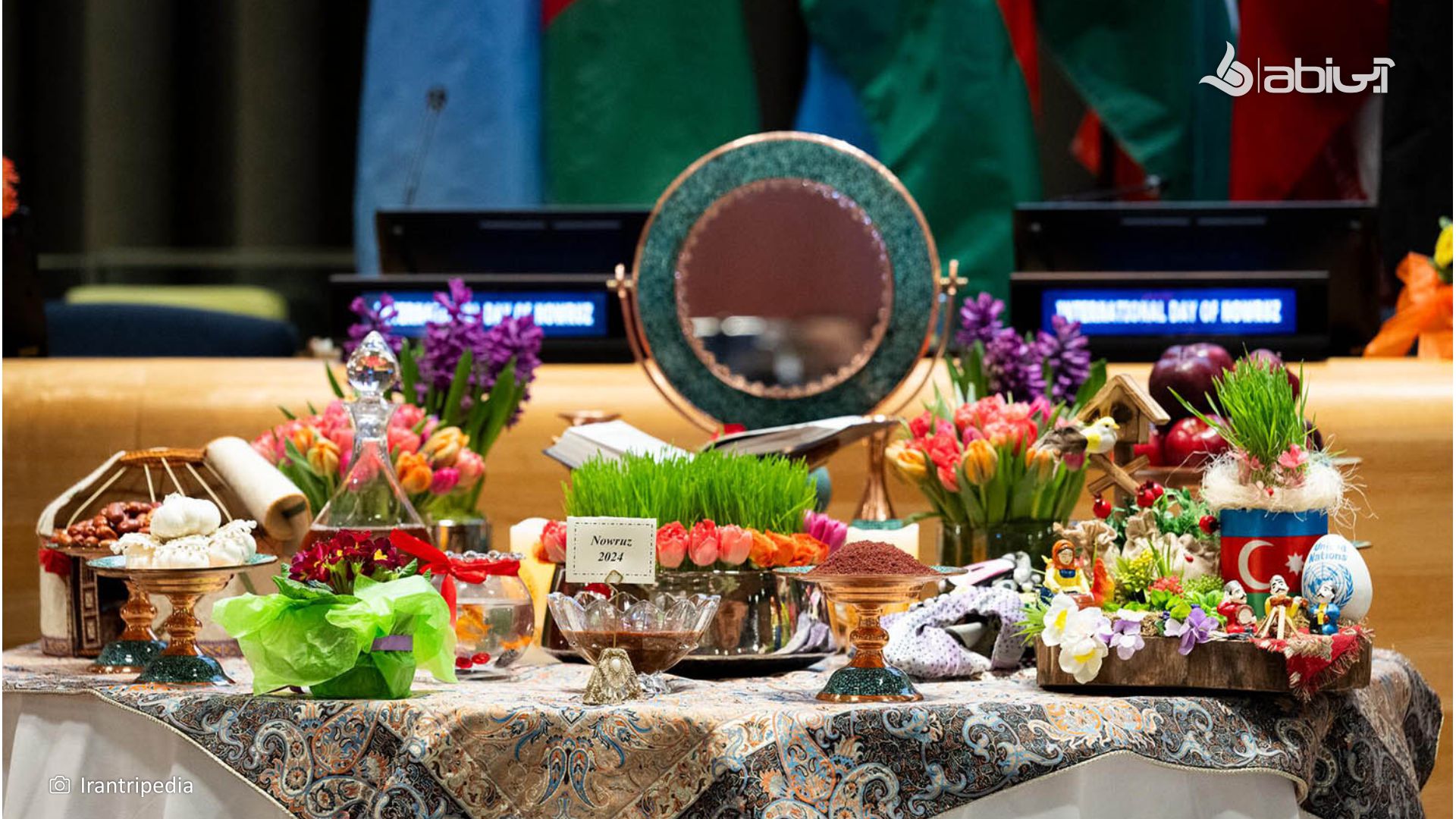
The United Nations, as the principal coordinating body for the world’s states, has registered Nowruz in its calendar and formally recognized it. On February 23, 2010, the UN General Assembly inscribed Nowruz as one of humanity’s most significant historical events in the list of cultural-historical heritage.[iv] Pursuant to this decision, each year on March 21, coinciding with the first day of the month of Aries, the UN Secretary-General issues a special message for this auspicious global day.[vi] UNESCO, the UN’s Educational, Scientific and Cultural Organization,[v] writes of Nowruz: “Nowruz is an ancient festival celebrated by eleven UN member countries and welcomed annually by 300 million citizens worldwide. Alongside its historical antiquity, it plays a major role in uniting the peoples of these countries.”[vii]
In line with the General Assembly resolution, the UN emphasizes these key points:
- Recognizes March 21 as International Nowruz Day;
- Welcomes the efforts of member states celebrating Nowruz to protect and promote Nowruz culture and traditions;
- Encourages member states to raise awareness of Nowruz and appropriately commemorate the day;
- Urges interested member states (those celebrating Nowruz) to study its roots and traditions, aiming to disseminate awareness of Nowruz heritage among the community of nations;
- Encourages interested member states, the UN and its specialized agencies (especially UNESCO), international programs and funds, and non-governmental organizations to participate in Nowruz celebrations.[viii]
Global organizations of high standing, such as the European Union and the Organization of Islamic Cooperation, also attach great importance to Nowruz. The EU maintains representations in all Nowruz-domain countries. The European Commission, which serves as the secretariat of this esteemed global body, organizes cultural programs for the worthy celebration of Nowruz. It also issues official declarations on this day, conveying support for this ancient festival, which is regarded as global cultural heritage by the peoples of this domain. Nowruz holds considerable significance for the Organization of Islamic Cooperation as well. The majority of Nowruz-domain countries are Muslim, so each year on March 21, the organization emphasizes cultural convergence, with its secretariat broadcasting and promoting supportive messages to the people living in this domain.
This widespread global support for Nowruz heralds the promise that Nowruz-domain governments should organize targeted cultural programs to coordinate among themselves, transforming this vital cultural event into a valuable process rooted in its history.
Nowruz’s Message from an International Relations Perspective
Nowruz offers three valuable messages to human society that merit attention. The first is the “friendship of nations.” Friendship among individuals, social groups, and lands creates opportunities for mutual understanding and resolving human society’s challenges. This message holds immense importance for the current state of human society.
The second message of Nowruz is “tolerance.” Tolerance, meaning forbearance and patience, enables the peoples of this domain to listen to one another and distance themselves from hatred, war, and enmity. Tolerance fosters mutual understanding and curbs conflicts at group and geographical levels within the Nowruz domain.
The third message of Nowruz is “ethical conduct.” Here, ethical conduct entails respecting human principles and dignity. Humanity becomes the central core of Nowruz’s messages, attaining an elevated status. This message aligns well with the Universal Declaration of Human Rights, which targets respect for human dignity.
The fourth message of Nowruz is forging the “human-nature relationship.” Nowruz ascribes high value to this bond, positioning it as a vital obligation toward human society. This duty involves humanity’s stewardship of our nature. The earth requires care from the humans who inhabit it, and the air demands appreciation from those who breathe it to live. Thus, it is humanity that must safeguard its relationship with nature.
The fifth message of Nowruz is flourishing. The first day of spring carries profound meaning for defining Nowruz. On this day, nature and humanity reach bloom and freshness, bringing fresh ideas for improving human life.
A careful review of Nowruz’s messages reveals their harmony with human society’s aspirations across other civilizations, paving the way and broadening the path for global convergence. Yet experiences and realities show that governing states in the Nowruz civilizational domain have not only failed to promote these messages globally but also neglected to utilize them in their internal relations. We consistently observe contradictions in these states’ political and cultural interactions, leading to estrangement rather than convergence and acceptance.
Nowruz’s Place in Cultural Diplomacy
Diplomacy links states’ domestic policies with their foreign policies on the international stage to advance the economic, social, and cultural development of nations. It forms a vital branch of political science, law, and international relations. In this context, diplomacy acts as a coordinator, effectively connecting these three domains. Cultural diplomacy’s task is to build bridges of human relations, elevating people’s understanding of history, identity, and lifestyles. By fostering connections, cultural diplomacy bolsters nations’ credibility toward one another. It narrows distances and encourages us to celebrate our culture, art, and history. Celebrating culture paves the way for political mutual acceptance among states. The Kennedy School of Government[ix] identifies four key outcomes from active cultural diplomacy.
The first outcome is mutual respect among states, made possible through constructive cultural relations. In these relations, states pave the way for nations to know one another via cultural diplomacy.
The second outcome is inclusivity, meaning that as members of the global community, we need shared interests to protect our nature and history, achievable only by building relations with one another.
The third outcome is acceptance: we must transform our aspirations, based on inclusivity, into acceptable strategies and take constructive, practical actions.
The fourth outcome prioritizes culture over politics, revealing the precedence of humans, their history, and culture over politics, which relies more on power.
The fundamental question now is whether Nowruz-domain member states have launched effective cultural diplomacy to promote Nowruz’s messages and outcomes. The answer is not very encouraging. While it would be unfair to claim nothing has been done, security, ideological, political, and economic reasons have prevented active, impactful cultural diplomacy in this domain from taking root. Some international relations scholars believe cultural diplomacy should become a constructive, dynamic element in states’ political agendas. They argue it reduces tensions between states and, specifically, border disputes among them. Resolving Durand Line disputes between Afghanistan and Pakistan, or contentious borders among Tajikistan, Uzbekistan, and Kyrgyzstan, requires active cultural diplomacy yet little has been done. A second challenge is lack of resources: these states allocate insufficient funds for welcoming and celebrating Nowruz. In reality, cultural agendas and soft-policy resource allocation for practical work are shaped by states’ hard-policy priorities in advancing cultural diplomacy.
Conclusion
In this article, I have sought to initiate a normative and value-based discussion on Nowruz’s importance in states’ international relations. I am fully aware of the Taliban’s stance on Nowruz. To me, the Taliban is a criminal group that once ruled part of the Nowruz geography and is unfortunately in its second round now. Talibanism, the most culture-hostile political structure in this geography, is infamous as the destroyer of the world’s largest Buddha statues. This culture-hostile group should not be lumped with this domain’s states, nor should we expect anything from it.
My analysis in this article yields a conclusion resting on five axes.
First, culture forms the foundation for political, social, and economic change. Societies that have implemented cultural reforms in power administration systems have successfully navigated political crises. For this, serious attention to education is essential, familiarizing children with their land’s history, identity, and culture. Awareness preserves culture and prevents the black claws of ignorance from choking art, literature, history, and freedom. I must note that an active education system plays a key role in shaping foreign policy doctrines and smoothing states’ international relations. Our aware citizens can, with insight and constructive reasoning, present Nowruz celebrations as a meaningful regional event to the world and introduce our foreign policy on global stages via active cultural diplomacy.
Second, preserving culture requires modern, national states. Experience shows that as modern, national states replace ideological, absolutist, and autocratic ones, cultural support spreads accordingly, strengthening constructive psychological and cultural ties in society. Thus, the culture of rule by a group or individual gives way to national culture or identity. National culture or identity counts among the cornerstones of foreign policy and states’ international relations. Nowruz is our finest symbol of cultural identity. Based on credible global research, Nowruz’s origin and base lie in our land, a tremendous asset for improving our international relations.
Third, supporting historical and cultural festivals in our land and region is the best revenge against culture, art, and history’s enemies. Intellectuals, enlighteners, civil society institutions, political structures, economic bodies, and academic figures must safeguard Nowruz’s ancient culture, inseparable from our historical identity.
Fourth, Nowruz is not merely an abstract name or recreational festival. It is a package of culture and customs embedding vital, valuable messages. This vast culture connects to poetry, stories, attire, cuisine, epics, and politics. We must unpack all facets of Nowruz and illuminate their roles. Institutions and academics should write articles, hold seminars and symposia, and launch awareness-raising research in each area of this grand cultural package.
Fifth, as an ancient festival, Nowruz has roots in our civic freedoms. Civic freedom means the liberty to practice historical and identity-based values, counted as citizens’ human rights. These civic freedoms first appeared in Cyrus the Great’s cylinder and underpin modern human rights today. We must introduce to the world the link between Cyrus’s cylinder and Nowruz culture’s emergence in our land, safeguarding one of humanity’s foundational rights, now called civic rights in contemporary literature.
i. Culture and Power by AKIRA IRIYE: International Relations as Intercultural Relations, Wiley Online Library https://doi.org/10.1111/j.1467-7709.1979.tb00305.x
ii. Culture and International Relations Journal Volume 19, 1996 by Michael J. Mazarr
iii. Political CultureJürgen R. Winkler https://www.bcom/topic/political-culture
iv. United Nations officially recognized the “International Day of Nowruz” with the Resolution64/253 by the United Nations General Assembly in February 2010.
vi. یونسکو در ۱۶ نوامبر سال ۱۹۴۵ به عنوان هماهنگ کننده برنامه های علمی، تاریخی و فرهنگی جهان در جنب سازمان ملل متحد تاسیس گردید. این نهاد دارای ۱۹۵ عضو است که از سوی دولت های عضو سازمان متحد معرفی میشوند.
viii https://8am.media/fa/the-place-of-international-nowruz-day-in-un-literature/
ixix.https://publicpolicy.pepperdine.edu/blog/posts/the-power-of-cultural-diplomacy-building-bridges.htm
